When talking to people about tattoos, one of the most common things one hears is “I would definitely get one, I just don’t know exactly what I want to tattoo”. That’s where I was for many years, and I would probably have stayed there forever, like most people do, if it wasn’t for Yosef, Limor, and the Third I.
That’s not completely true. I knew what I wanted: it was a turtle. If asked why, I would say I’m a bit like a turtle myself: I like feeling safe and protected, always having available everything I need to survive, and when venturing outside my comfort zone, never going so far as to lose the ability to come back at any moment.
This is not bad for a personal connection to a tattoo. But the fact remains that I never got that turtle tattoo. Maybe it hadn’t felt profound enough, or maybe I wasn’t sure I’d always remain that person, and a tattoo is forever. So in some sense I would always wind up back at square one: I wanted a tattoo, but never definitely figured out what it was that I wanted.
I’ve known Yosef for a quarter of a century (it is, for me, as dramatic as it sounds), and I can hardly name another person with whom I have a better mutual understanding. So when he was telling me about his development of the concept of the Third I, it was clear to me from the get-go that I would take part in it at one point or another. Yosef moved to Berlin, however, and all this seemed quite far away. Then in February 2017, the never-converging parallel lines of our lives were about to meet: I was going to Berlin, and Yosef and Limor were ramping up the Third I project, preparing for its unveiling. This was the right opportunity. Yosef and I started our sessions via video calls.
The idea of the Third I is really quite simple, and one cannot help but marvel at its ingenuity. For some people it’s enough that they like an image, and think it’s pretty, to go ahead and ink it on their body. Boy, I wish I was so spontaneous and happy-go-lucky. Most of us want something more than just to like the graphic. But what is that something? How do you get at it?
The truth is, like with any kind of soul-searching, you benefit a lot from the insight of another pair of eyes (or the “I” behind them, if you will). Especially if they’re trained and experienced and know where to look. And that is precisely the premise of the Third I.
We started our sessions by trying to work with the turtle concept: what does the turtle mean to me, what does it represent, and where has it come from? I had already mulled these questions before, so this topic gave us an easy start, but it had the obvious flaw of drawing the target around the arrow. If we intended to arrive at something that would reflect genuine and profound facets of my personality, then we had to use this topic as a stepping stone backwards, away from the graphic, and deeper into me.
At the end of the first session, after we were done discussing all the different favorable (as well as the disagreeable) traits of the turtle, Yosef left me with a question which I can’t quote here, because frankly I don’t remember it, and neither did I remember it then, when he asked it. Apparently I had heard what I needed to hear, and not what Yosef said, and we must consider such mistakes fortuitous. So for the following week I walked around with my own question bobbing in my head: “What drives you?”
I was mad at this question, because it felt important enough to demand an answer, yet I was drawing a blank. Eventually I did cobble together some ideas, and as it happens, those became the building blocks of the remainder of our conversations, and ultimately of the tattoo itself. My mistake wasn’t in vain.
What drives me? Ultimately, I think, it’s the wish to understand, and consequently, my biggest frustrations come from things which cannot be conquered by understanding. How is it that perfectly intelligent people can have such different beliefs and moral value systems? What does this multitude of conflicting beliefs tell us about the existence of objective truth? And if we can’t even take objective truth for granted, then what is left for us to understand?
I grew up and spent my formative years in an religious orthodox community. After leaving it, for a while I was self-contentedly espousing militant atheism a-la Dawkins. I thought I was rebelling against faith, and it took years to register in my mind that as I left the faith I grew up in, all I ended up doing was switching to another. Merely swapping the source of one’s arrogance is not much of a progress in the way of self-development. A middle path must be taken. But is there any possibility at all to form a world view devoid of any faith? And would I even want to?
So another question ended the next session: “What do you believe in?” This isn’t an easy one either. After all, trying to understand faith is fundamentally an exercise in frustration. The phrase itself is almost an oxymoron. Yet this is a struggle which has been accompanying me my whole adult life. I mentioned to Yosef that the futility of it felt to me like trying to grab and hold water with bare fingers. Or, at its least frustrating, like caressing water; touching but never falling into, engaging but never embracing. Unbeknownst to me, this conversation turned out to be a moment of conception. The turtle was sent on its way to a quiet demise (or hibernation–who knows), and another idea began taking form.
We took a break from the sessions to process the accumulated material, and after a while Yosef called to say that they’ve come up with a graphic I’m going to fall in love with. He suggested not to share it via the video call, but to show it to me in person when I flew in for my visit. I’d have to contain my curiosity for a whole month, but I decided to go for it.
When I finally saw the graphic, it looked like nothing I had ever imagined. I was taken aback, and just sat there for a full five minutes staring at the printout. At the end of those five minutes, though, I knew that I wanted to have this on my body. We went through a couple of iterations, ironing out some graphical details, and on the next day I sat in for the inking.
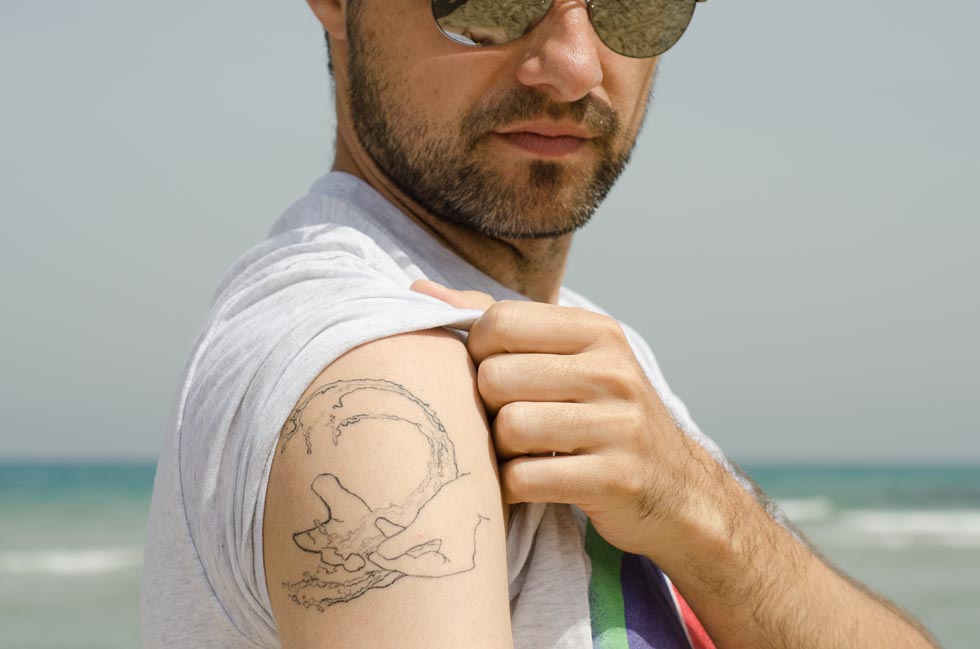 When I look at it now, I’m still surprised every time at how this idea came into being, and how candidly and precisely it associates with who I am. Such personal tattoos, which mean the world to their bearer, can be quite opaque to everybody else, and sometimes I wish that mine spoke more loudly, was more comprehensible, less enigmatic. But the deep connection that I feel to it every time I see it in the mirror is something that I would never trade for any other quality. It reminds me of the defining times of my life, and of the awesome people I’ve had the fortune to be connected to. And frankly, I’m more than happy to embrace the enigma.